How to Run a Fair Youth Flag Football Draft
Run a fair youth flag football draft by rating every player on a consistent scale, running a snake draft so pick order alternates each round, protecting coaches’ own kids and sibling requests up front, and balancing teams on total skill — not just star players. Publish the rules before draft night so no parent is surprised.

Updated July 24, 2026
A draft is the single most scrutinized night on a youth flag football calendar. Get it right and the season runs itself; get it wrong and you spend twelve weeks answering "why is that team stacked?" emails. After running drafts across many seasons and dozens of divisions, the pattern is clear: fairness is a process problem, not a talent problem. Below is the process I trust.
What makes a youth flag football draft fair?
A fair draft uses one consistent rating scale for every player, a repeatable pick order that no single coach controls, and written rules published before draft night. Fairness comes from transparency and balanced total team skill — not from any one team missing out on the best athlete.
Parents rarely complain that their kid lost. They complain that the process felt rigged. So the goal is not a perfect competitive balance — that is impossible with real children — it is a process every coach and parent can watch and agree was even-handed. Three things do the heavy lifting: a single rating scale, a neutral pick order, and rules written down in advance.
How do you rate players before the draft?
Rate every player on the same simple scale — a 1 to 5 skill number works well — using a short evaluation or last season’s coach ratings. Keep the criteria consistent (speed, catching, understanding of the game) and have more than one evaluator when you can, so no single opinion sets a child’s value.
You cannot balance what you have not measured. Before draft night, every returning and new player needs a rating on the same scale. A 1–5 number is enough for youth ball — you are sorting, not scouting the NFL combine. Run a short evaluation session (40–60 minutes of routes, catching, and a light scrimmage) or, for returning players, average the ratings their previous coaches submitted.
Keep the criteria identical for every kid
- Speed and agility — can they separate and change direction?
- Catching — hands, not just effort.
- Game understanding — do they know where to be?
- Flag pulling / defensive instinct.
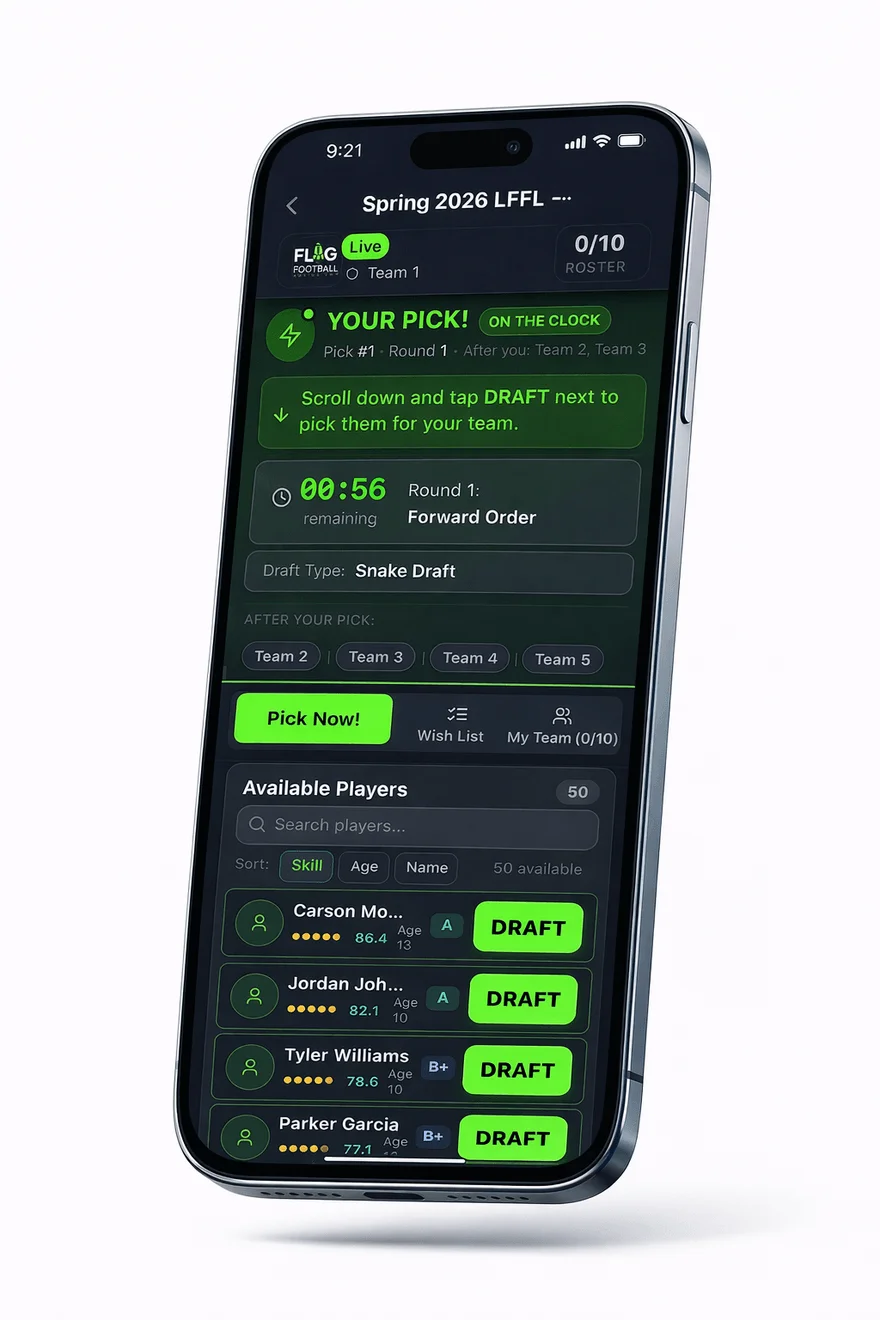
Use two or three evaluators and average their scores. One person rating 120 kids is one person’s bias applied 120 times. Ratings are the raw material a draft tool needs to build even teams — our Roster Right draft tool balances on total team skill from exactly these numbers.
Snake draft or straight draft for youth leagues?
Use a snake draft. Pick order reverses each round — the coach who picks first in round one picks last in round two — so no team collects every top pick. A straight draft, where the same order repeats every round, hands a lasting advantage to whoever drew the first slot. Snake order is the fairness default.
In a snake (serpentine) draft, order runs 1-2-3-4 in round one, then 4-3-2-1 in round two, and keeps alternating. The team with the first overall pick pays for it by picking last next round. Over a full draft the pick values roughly even out, which is exactly what you want when the "assets" are eight-year-olds.
How do you handle coaches’ kids, siblings, and friend requests?
Protect a coach’s own child and one assistant’s child up front by assigning them to that coach’s team before the open draft, then charging their skill rating against an early-round pick so the team isn’t stacked. Honor sibling requests the same way. Cap friend requests hard — promise nothing you can’t balance.
Every league has to answer three questions before draft night, and the answers must be written down: Where do coaches’ kids go? What about siblings who need the same practice night? How many buddy requests will you honor? The fair mechanic is a "protected pick." A coach keeps their own child, but that child’s rating is deducted against a matching draft round — protect a 5-rated kid, forfeit an early-round pick. That way protection is a right, not a loophole.
- Coach’s child: auto-assigned, charged to the round matching their rating.
- Siblings: kept together for logistics, one charged as a protected pick.
- Friend requests: cap at one, honored only when it doesn’t break balance.
Roster Right handles protected picks and sibling keeps automatically and shows the balance impact live, so you are not doing this math by hand at 9pm on a projector.
What should you do the day of the draft?
Lock ratings and rosters the day before so nothing changes live. On draft night, display the board where every coach can see it, announce each pick out loud, and let the tool flag when a team is drifting out of balance. Export final rosters immediately and send them to coaches before anyone leaves the room.
The draft itself should be boring — that is the sign it is working. Everything contentious was decided in advance. On the night, run it on a projector so the board is public, announce picks so there is a shared record, and watch the balance indicator. When you finish, export rosters on the spot. A draft that ends with printed, emailed teams ends the argument; a draft where rosters "get sent out later" invites second-guessing.
A simple draft-night checklist
- Ratings and protected picks locked (done yesterday).
- Round-one order drawn publicly.
- Board visible to every coach.
- Each pick announced out loud.
- Balance checked before finalizing.
- Rosters exported and sent before coaches leave.
If your league still runs drafts on a spreadsheet, the Roster Right draft tool does the rating math, snake order, protected picks, and live balancing for you — and if you want a second set of eyes on your whole operation first, the free league audit is a good place to start.
Founder of Flag Football Advice and co-owner of Louisiana Flag Football, which he grew from 175 to over 2,000 athletes. He writes from years of operating real leagues. More about Gavin.
Published July 24, 2026 · Updated July 24, 2026